
Re-membering Our Deep Humanity
There’s a poem that won’t let me go - I think it wants to speak to these times.
I don’t recall when I first heard Cofio, by Waldo Williams (1904–1971), but I remember learning to recite it for an Eisteddfod (a Welsh cultural competition) sometime in my early teens. Even then, it had lodged within me, wrapped its tendrils around the threads of my becoming. It was the invocation of the old things of humankind — precious and sacred— that stirred me; and the poet’s conviction that we were somehow impoverished by their forgetting.

Un funud fach cyn elo’r haul o’r wybren,
Un funud fwyn cyn delo’r hwyr i’w hynt,
I gofio am y pethau anghofiedig
Ar goll yn awr yn llwch yr amser gynt.
Fel ewyn ton a dyr ar draethell unig,
Fel cân y gwynt lle nid oes glust a glyw,
Mì wn eu bod yn galw’n ofer arnom –
Hen bethau anghofiedig dynol ryw.
One fleeting moment as the sun is setting,
One gentle moment as the night falls fast,
To bring to mind the things that are forgotten,
Now scattered in the dust of ages past.
Like white-foamed waves that break on lonely beaches,
Like the wind’s song where no one hears the wind,
They beckon us, I know, but to no purpose –
The old forgotten things of humankind.
Forty years older — and hopefully a little wiser — than when I first learned it, this poem feels as though it is calling to these increasingly volatile and confusing times. As our flawed yet familiar systems crumble, and the values of the old patriarchal, capitalist paradigm - hierarchy, control, competition and short-term profit - strain against emerging values of collaboration, sustainability, wholeness, interconnectedness and long-term well-being, our daily lives resound with discord. And, we've taken our grand experiment with the cult of individualism about as far as our brittle sanity will allow, isolated ourselves in sterile ivory towers built from our own empty sense of superiority, and now stand looking out to the four directions, bewildered by the dying beauty of our world, aching for some old, better time and sense of belonging that we can just about remember in our bones. As I think on all this, the sentiments of the first aching verses of Cofio come all too easily to mind.

Waldo — as he is generally and affectionately known in Wales — also lived through turbulent times and championed more humane values. A notable Christian pacifist, anti-war campaigner and Welsh nationalist, he was dismissed from a headmastership as a conscientious objector during WW2. During the Korean War (1950–1953), and until compulsory military service ended in 1963, he refused to pay income tax on pacifist grounds. As a result, bailiffs seized his goods, and he was twice sent to prison. Someone once said it had taken two thousand years of Welsh civilisation to create a man such as Waldo. He embodied the ancient bardic tradition, as well as the spirit and long history of these lands.
In the verses of Cofio, written in 1931, Waldo calls to mind the artistry and skills of early peoples, their small buildings and great halls, their well-told tales, old gods and belief systems, and then the innumerable ancient languages now silenced. There is such hiraeth – such a deep, haunting ache for the beauty, skills and wisdom that seem to Waldo to be just at the edge of remembering.
I can’t help wondering whether we are living through an age of re-membering these old forgotten things of humankind right now — not as some worthy act of historic conservation or re-enactment of the past, but as a profound enquiry into the wisdom and skills of our ancestors and how they might help us retrieve the lost and exiled parts of our humanity and lead us home to communion with all life.
Hardly a week goes by without my coming across a course, essay or conversation about the value of old knowledge and technologies in building more sustainable futures; or an ‘aha’ moment as ecologists recognise the value humans once brought to creating and sustaining ecological and habitat diversity. Just a few weeks ago, I spent a memorable afternoon speaking to graduating students at Black Mountains College (www.blackmountainscollege.uk), who’ve been studying practical skills and degree programmes focused on sustainable futures and ecological restoration. Interestingly, most of the College’s diplomas centre on practical skills: coppicing and greenwood trades, forestry and arboriculture, regenerative horticulture, nature restoration, and more. While many of these courses employ both power and hand tools and draw on new ecological and scientific understanding, the foundation of the skills, knowledge, and philosophy of working with the land is undeniably ancient, another reaching back into our past so that we may generate a better, more sustainable future.

On Saturday, I returned home from running some talks and workshops at Medicine Festival. There, I found ten thousand people — mostly under 40 — seeking old ways of being in reverence and alignment with life: listening to indigenous elders, exploring ancient modes of healing, dancing, singing and honouring life through ceremony. As we drove up the hill, we were met by plumes of dark smoke rising from our home mountain, Mynydd Cynrhos. A wildfire had kindled in the scrub, fuelled by dry moorland peat, grass, gorse and heather had burned across the mountainside. Although local farmers worked tirelessly alongside fire crews all afternoon to bring the blaze under control, the fire slumbered in the peat, re-igniting around noon the next day, and the next, and the next.
As well as feeling disheartened by the carbon released into the atmosphere and the loss of habitat, I have been deeply moved by the way the community has come together to support one another, offer help and provide comfort. Yes, there have been some undignified squawks and squabbles on local social media streams, but overwhelmingly they have been drowned out by support, gratitude, cooperation and positive action. This, it seems, is a common human response.
Some weeks ago, I listened to a dear colleague and friend, Cassie Robinson of The Steadying (see www.thesteadying.org), give a talk about what their research has shown about how humans respond to crisis. There are several terms to describe the positive human and community responses they observed during sudden, natural disasters across the world. These include mutual aid, which refers to voluntary, reciprocal resource-sharing and cooperation, where communities organise themselves to meet critical needs during crises. Other related concepts include disaster collectivism, collective resilience and catastrophe compassion.
And here is the bottom line: we humans have thrived as a species more through collaboration than competition. From the earliest hunting groups to the rise of towns, farms, roads, trade networks and nations, human progress has depended on our ability to cooperate, share knowledge and protect one another in difficult situations and environments. Competition has certainly played its part, pushing groups to invent, adapt and improve. But collaboration turned short-term survival into lasting civilisation. Some deep part of us remembers this and is called forth by the calamity of our world. When the stakes are high, our spirit soars and we remember that we are more than frightened beings who hoard bog roll: we are compassionate, caring and collaborative.
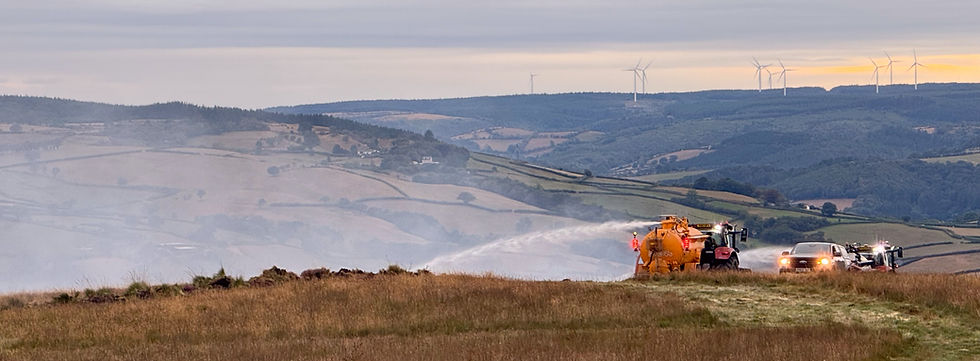
As I talked to neighbouring farmers and fire crews and surveyed the charred remains at the top of the mountain last night, I saw green shoots of community resilience breaking through the blackened earth. It may be that, as we continue to be humbled by increasing climate catastrophes and the fallout of geopolitical and economic collapse, the old values of humankind — collaboration in particular — may yet come to the fore, rising like a phoenix, bringing us home to ourselves in ways that could transform society.
As we tip into polycrisis, we will need more of our ancient, tried-and-tested human technologies to keep us sane and keep us bonded, and thankfully, many are already reinvigorating them: from the exponential rise in pilgrimage to the adoption of fire-centred circles as spaces for convening community conversations, counselling and mental health support groups, and progressive business strategy meetings. As we feel the overwhelming, natural urge to escape those self-imposed ivory towers and return to community (whether in person or online), we will also need ceremony. For at least 130,000 years, ceremony has been our way of communing with the ineffable, marking the thresholds of life and death, and attuning ourselves to the tides of the turning year. Ceremony and ritual have helped our communities metabolise grief and gratitude, honour growth and transformation, and mark the rites of initiation that carry us through the many thresholds of a life. In short, they have helped keep us rooted and aligned with all life. We will need this technology now more than ever.
Waldo concludes the poem thus:
Mynych ym mrig yr hwyr, a mi yn unig,
Daw hiraeth am eich ‘nabod chwi bob un;
A oes a’ch deil o hyd mewn Cof a Chalon,
Hen bethau anghofiedig teulu dyn?
Often at close of day, when I am lonely,
I long to know you all, bring all to mind;
Is there a heart or memory still to cherish
The old forgotten things of humankind?
As I re-read these lines, I want to shout, “Yes! Yes, it is us — this generation, now!” We are cherishing the old things of humankind; we are re-membering them. We are coming home to our deep humanity. And as we re-member what it is to be relational humans, we create the possibility of remembering — just in time, perhaps — that we are inextricably bound, by deep, poetic, gossamer threads, to all life on our beautiful Earth.
The translated excerpts of Cofio by Waldo Williams are by Alan Llwyd.
TAKING YOUR LEARNING JOURNEY FURTHER
To find out more about Waldo Williams, please visit www.waldowilliams.com
If you'd like to learn more about CEREMONY, you may be interested in Anian's forthcoming year and a day-long apprenticeship.
For the Reading Pile: I Eat the Stars: How to Live Fully and Beautifully in a Collapsing World by Sarah Wilson. Published in mid-2026, it explores complex systems collapse and civilizational decline, drawing on hundreds of interviews with scientists, philosophers, and spiritual leaders to offer a guide on how to live with meaning and joy rather than despair.
The mission of Black Mountains College, is ‘learning to live in a warming world.’ It is a new institution dedicated to teaching skills relevant to changing current systems. Find out more at www.blackmountainscollege.uk . See also places like Schumacher college www.schumachercollege.org for inspiration and programmes that embrace and prepare for the challenges ahead.
If you're curious about ways to respond to systems collapse, check out The Steadying www.thesteadying.org . The Steadying integrates the hands-on competencies of emergency preparation and response with relational infrastructure, psychological resilience, and ecological connection. (You might need to give them a couple of weeks, as they're preparing to launch the website).


Comments