
What the Ash Knows - Reclaiming Animate Language to Heal our Separation from the Natural World

How can I express what this great Ash means to me?
This English language I share with so much of the world has lost the animacy that once suffused its vocabulary. In my mother tongue, Cymraeg ~ Welsh, words survive that honour interbeing and the delicate sensations of our connection with all life; by using them, like spells, they bind us anew. Likewise, Cymraeg's grammar continues to invoke the 'beingness' of all things, addressing trees, rivers, birds and even field gates and computers as he and her (or both, though we do not use the gender neuter of German). So we are bound to the web of life by our utterance, renewing invisible chains of interrelatedness even as we chat about the weather or gossip about neighbours.
I'm not sharing this here to diminish the English language - far from it. I spent three happy years delving deeply into Saxon, Middle English and English Literature at university and have a deep respect for the beauty of the language and its literature. But, as an animist with a foot in two languages and two cultures, and as a teacher of animist practice, I see very clearly how English does not easily lend itself to expressions of deep relationality with the natural world, a binding that more and more are seeking, called back to the land and her kin by something essential singing in the bones, and an urgent imperative to regain ways of relating, caring and protecting as we plunge headlong into climate collapse and all that means for our precious Earth.
So what might we learn from other languages? How might English begin to reclaim a vocabulary, coin new words and shift its grammar? This is a question that many are currently asking, including writers like Robert McFarlane (see Is a River Alive?) and Robin Wall Kimmerer (see Braiding Sweetgrass). I'm currently working with a fantastic bunch of animists from across the world also asking this question and putting their minds to it. There is no one answer, and it is not for one person or even one group alone to conjure the words. So, we are consulting with people in festival fields and at conferences to help find the words you are yearning for (click here to discover more). One thing we all agree is that in order to reclaim what has been lost, we need to understand what is missing - we need to 'map the gaps', and this is where comparisons with other languages and cultures are helpful.
The bardic tradition of Cymru ~ Wales runs green with intertwining and interbeing. It was not always just ours. Until the establishment of the Saxon kingdoms from the 5th to 7th centuries, this tradition was rooted in different tribal manifestations across mainland Britain (Ireland also had its own, but its history is different). When the Britons were pushed into the corners of what are today Wales, Cumbria and Cornwall, the bardic tradition continued, petering out in Cumbria when it was later conquered by Saxons. The old 'lore' of the Britons was kept alive by the bardic schools in Wales and Cornwall, later dying out as a living tradition among the Cornish. Happily, though it has changed significantly in terms of structure, schooling and ceremonies, the Bardic tradition remains alive within the Cymraeg-speaking culture of Cymru.

The lore that seeps like sap through our myths insists that all beings are porous to each other, and can experience each other's beingness through deep empathy and imaginative or energetic possession. The tradition attests that we are not simply created 'of mother and father', but, to quote Taliesin, one of the fathers of the Bardic tradition, also of fruit of fruits, primroses and flowers, the blossom of trees and shrubs. We are made of the earth, from the sod, from nettles and the waters of the ninth wave. To this day, you will often hear eulogies describing individuals as being a man or woman of their 'square mile' - y filltir sgwar, celebrating a numinous, profound and utterly intertwined relationship of biology, geology, mineralogy, personality, culture, love and care between person and place.
This particular empathy, capacity for relationality and the focus on what binds us rather than separates us in the web of life, we describe in Cymraeg as anian. A further capacity to imagine ourselves potently - some might say 'shamanically '- into the lived experience of other beings was likely a core component of the training of our early bards; certainly, attesting to this capacity formed a vibrant thread of early bardic verse both in Wales and Ireland. Our master bard Taliesin sang:
I was a droplet in the air,
I was the stellar radiance of the stars
I was a word in writing
I was a book in my prime
I was the light of a lantern.....
~ from Kad Goddeu, The Battle of the Trees,
Similarly, his Irish contemporary, Amergin asserts:
I am the wind on the sea.
I am the wave of the sea....
I am a strong wild boar.
I am a salmon in the water.
~ from Leabhar Gabhála, The Book of Invasions
To this day, a sense of entwining between the natural world and humanity abides in our poetry. It is something particular, carried within the tradition and an immensely long relationship with this land, that stretches back through our ancestral lines to the people who repopulated these isles at the end of the last Ice Age, some eleven thousand years ago (Source: University of Oxford). I have never found its like in expression in English literature, though Hardy comes close in some of his novels and some of the Saxon elegies and poems such as The Seafarer and The Wonderer lean towards it.
I'm grateful to the careful work of Carwyn Graves and his excellent new book, Cynefin - Wisdom from a Thousand Years of Welsh Nature Poetry, for drawing out this distinction so powerfully. He opens the book with an englyn written by one of our living bards, Myrddin ap Dafydd, composed in 1990 as an elegy for a local man, Cledwyn, whose craft was laying hedges. His skill would have been visible long after his death in the lushness and effective livestock boundaries of his laid hedgerows. This englyn was composed by the poet for the local community, as part of the communal remembrance and honouring of this local man.
Yn nhwf y drain, mae'i fedr o - yn gwynnu
Yn gân wrth ei gofio
Hwythau'n cyll, ym mhlethau'r co,
Gan ei wên sy'n gwanwyno.
While an English translation cannot do justice to the exquisite alliteration, rhythm and flow of the ancient cynghanedd that binds each line, and each line to the others, Graves has translated it well:
In the thorns' growth his skill - blossoms white
Into song as it remembers him,
And woven the hazel rods still,
Under his smile here spreading.
It is the hedgerow that sings Cled's elegy, eloquently through its flourishing. Something of the deceased man abides in the blossoms and remains entwined with the woven rods. This kind of impulse, of interbeingness is natural and commonplace within our poetic tradition. As a consequence, it continues to infuse Cymraeg-speaking culture, though maybe we are not generally aware of it in the day-to-day.
Graves goes on to compare this englyn with lines from William Wordsworth's celebrated and much loved poem, The Daffodils:
I wondered lonely as a cloud
That floats on high o'er vales and hills,
When all at once I saw a crowd,
A host, of golden daffodils....
Graves is not disparaging the beauty and art of Wordsworth's poem at all, he is merely pointing towards a difference in the animate sensibilities of Welsh and English culture. The separation between humanity and nature pervades English-speaking cultures. It is noticeable here in the self-awareness of the poet and the implied 'I' first person, despite the clear awe and delight at the natural world which exudes from every petal of Wordsworth's poem. It is very different from the interbeingness invoked by Myrddin ap Dafydd.
It was not always so in the English language, nor in the cultures it has come to inform. It is possible to track the incremental steps of separation through the linguistic shifts, initially and very markedly from Saxon as it encounters Norman French and develops into Middle English. At this point, the old grammatical forms of Saxon, which, like Cymraeg, used the pronouns he, she, they, for all things, are dropped, and English adopts his as the possessive form for neuter (non-male/non-female) nouns such as 'the book and his cover'. The Oxford English Dictionary cites 1577 as the year the deadening 'its' first snuck into the language: found in the writings of translator Ralph Robinson "There stands a bedde, its death to tell." When the word first gained popularity in the late 1500s and 1600s, it was commonly written with an apostrophe as it's, and the standard 'its' only emerged during the 18th century to separate the possessive determiner from the contraction it's (meaning 'it is' or 'it has').
What I notice as I work with English speakers endeavouring to cross the linguistic and cultural divide between humanity and the natural world is that they have to work harder than those who carry a language that remembers the beingness of all life. English does not validate their budding feelings of connection with words, and so the culture they swim within has no acceptance of our birthright of knowing ourselves as one with all life. I honour all who try. It is a hard journey to undertake alone, far easier within a community - physical or online - in which the numinous sensations and budding belief in connection can be witnessed, honoured, acknowledged, and gradually normalised as just the way things are. Every person who undertakes that journey does so on behalf of us all, healing a rift that is centuries old, a breach that is killing our world.

So, back to the question: how can I express what this great Ash means to me?
Ash is resonant in our culture; it is a spirit tree, a protective guardian and deeply magical - so much so that Gwydion, the great and somewhat troublesome magician of the Mabinogi, made his staff of this wood. We even immortalised this beautiful tree and their place in our landscapes in the folk tune, The Ash Grove. It knows a thing or two, the Ash.
My mother tongue and culture have nurtured me to sensations that English has no words for, and yet, I want to reclaim a way of sharing experience through English which is soulfully true to my experience, in the hope that many of you will instinctively relate to it, because it is our deeper, older way of being enwebbed with all life. It is perhaps part of the endeavour of many animist and pro-nature writers of this time, but English doesn't make it so easy for us. So, here goes.
Ash and I are bound by hill, fur and feathered kin, this love of an upland scratch of land and a care that flows through xylem and phloem, vein and artery. He is guardian of all he senses through green stomata and woody lenticels. We are bound in ‘anian’, a resonant empathy that flows from the well-spring of life pulsing through us and united by delight at the wild beauty of this small corner of creation we share. Wise beneficence flows from atop the hill like rivulets of moonlight coursing through the earth, and I track his guidance in glimmering dreams and sublime synchronicities. I do my best to respond, putting my hands to cultivating and cajoling a flourishing of life. I don't always get it right, but his heartwood is patience.

We sit in presence, our roots tangled, basking in serene companionship. Even when I'm away from this land, we are entwined in presence, in empathy and imagination. My comings and goings are beyond his lived experience, just as his rootedness is beyond my own, and yet all experiences become possible and are evoked by the meeting of our differences and our capacity to commune. The slow inhale and exhale of Ash is stronger than the frantic pace of two-legged life, so our human family is pulled to live by arboreal time; appreciating the vista of centuries while savouring the present.
I call him Yggdrasil for the World Tree of the Norse Gods - I don’t know what he thinks about that - he doesn’t seem to have an opinion, though I can’t help wondering whether he has a name - perhaps it is a secret name I cannot know, or maybe I haven't yet earned the right.
On vicious days of autumn squalls, he sways. Yggdrasil has withstood every strong wind, each hot summer and freezing winter for over two hundred years, though sometimes he casts a bough or branch - shedding what no longer serves in order to survive. In rooting deep, he stands strong, and so far, despite brutal climate changes that threaten this land, these lives, and this relentless, burning summer, he draws sustenance from the deep earth, and his mantle is green. In this and so much more, he is a teacher.
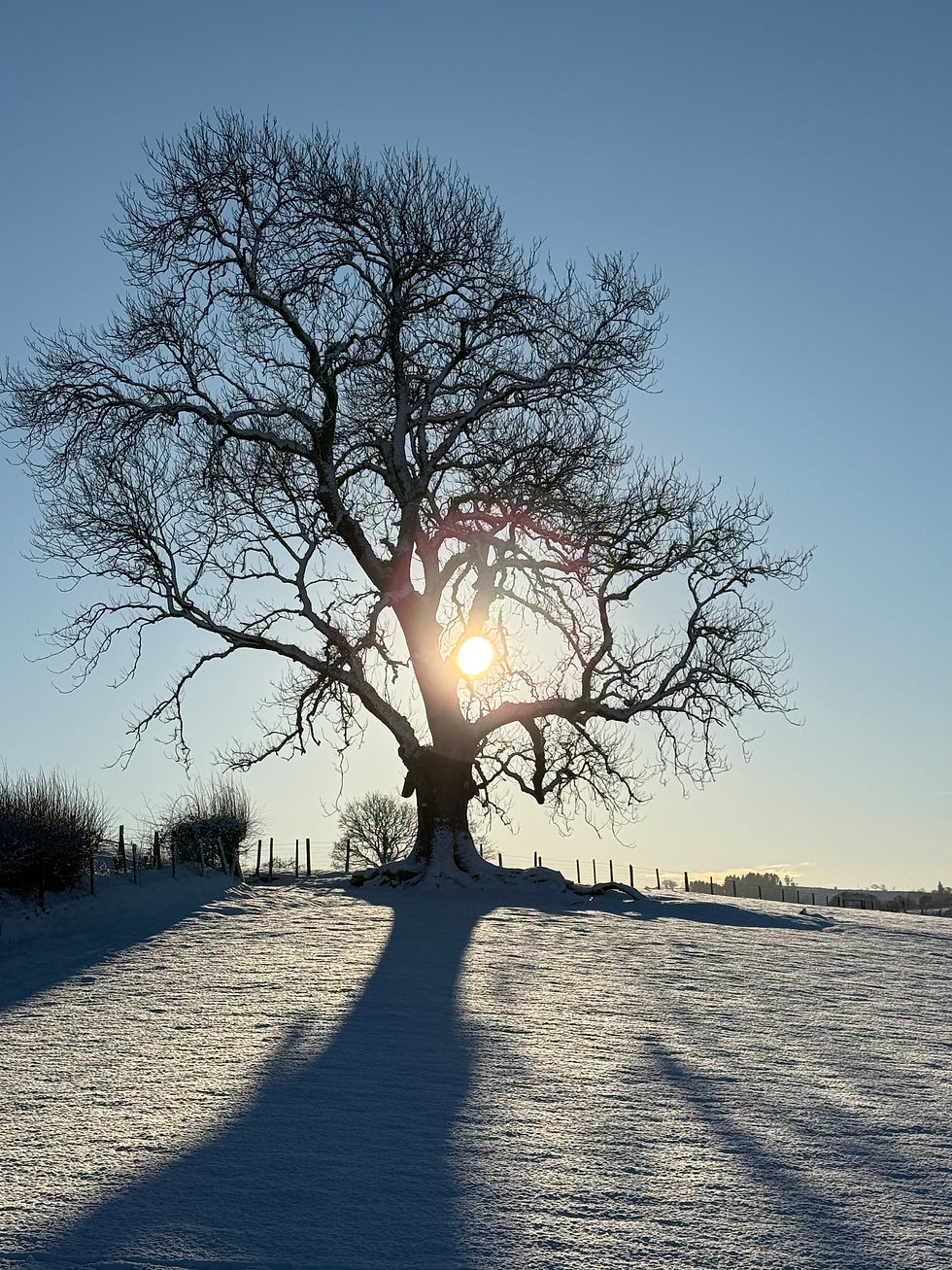
He is dying - he knows this and seems content, yielding to the mystery of renewal that awaits. An oak sapling grows in his shade - planted as a companion and apprentice. I ask Yggdrasil to teach this youngster all the history and lore of this place, the song of the four winds, the morning greeting for the Cothi river, the honour song of Mynydd Cynrhos and the secret calls that bring the swallows home to nest and the cuckoo to invoke the summer, this and the myths from the very beginning of time that we humans have forgotten. I am already grieving a time when he may not stand sentinel atop the hill - but who knows which of us will fall first? Whichever way, through one another, somehow we will both remain.
DISCOVER MORE
Animist expression in Welsh Poetry
Cynefin - Wisdom from a Thousand Years of Welsh Nature Poetry by Carwyn Graves. Published by Calon 2026
Taliesin and the Bardic Tradition
Taliesin Origins by Dr Gwilym Morus-Baird. Published by Celtic Source, 2023
Genetic history of the British Isles
Universty of Oxford: Who do you think you really are? A genetic map of the British Isles
For more on the Growing Words project, and to have your say, click here
Books that discuss the need for 'a grammar of animacy'
Is a River Alive by Robert McFarlane. Published by Penguin, 2026
Braiding Sweetgrass by Robin Wall Kimmerer. Published by Penguin, 2020

Comments